The Safety Car Paradox: Crises Reveal Your Best Leaders
February 9, 2026
The Feedback Paradox: When Performance Reviews Fail
February 12, 2026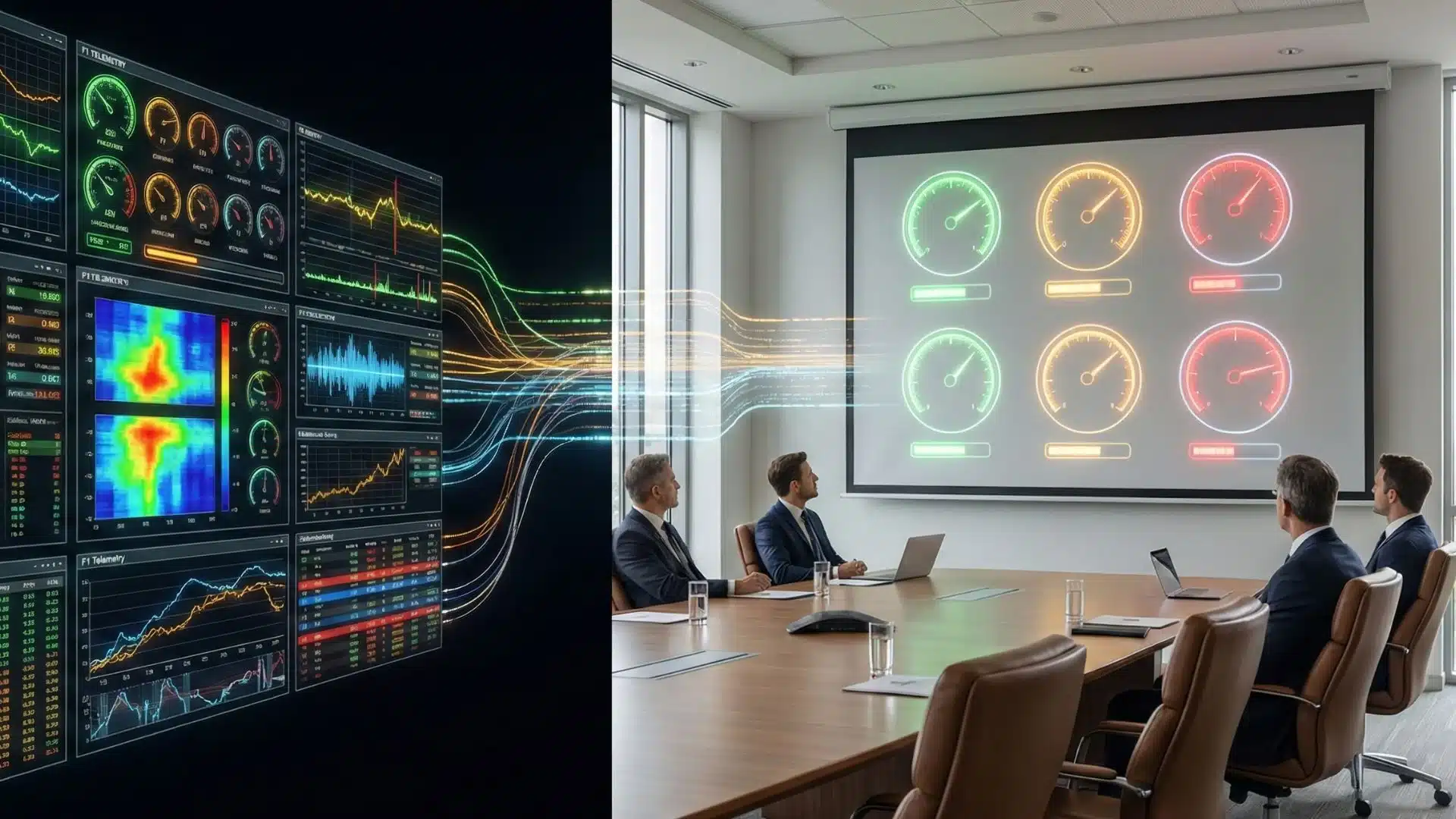
Director Telemetry: Reading What Credentials Can't Show
You're evaluating the wrong signals.
The resume says Harvard MBA, three successful exits, two decades of operating experience, and current board seats at four high-growth companies. The references check out. The interview is polished. The credentials are impeccable.
None of it predicts whether they'll actually make your board more effective.
Credentials show lap times. Telemetry shows capability.
Two directors with identical resumes can have completely different governance impact. Traditional board search evaluates candidates' track records, schools attended, companies built, and deals closed. The Director Telemetry™ evaluates how it'll perform in your specific conditions.
And that last phrase matters: your specific conditions. There is no universally good telemetry, only telemetry that matches the board context. A director with weak cultural code-switching might be perfect for a single-market board and disastrous for cross-border governance. Red signals aren't universally disqualifying. They're disqualifying when they conflict with what your board actually needs.
I've watched boards add impressive directors who somehow make the room less functional. Strategic output declines. Decision velocity slows. Productive disagreement turns into persistent friction. On paper, the board got stronger. In reality, it got weaker.
The pattern is predictable. What's missing is the telemetry.
The Race Engineer's Advantage
Watch race engineers during Formula 1 qualifying. They're not watching the car. They're watching data streams.
Throttle position. Brake pressure. Tire temperatures. G-forces. Steering angle.
Two drivers in the same car post lap times within hundredths of a second. From the grandstand, they look identical. But the telemetry tells completely different stories.
One driver is at the absolute limit, maximum braking points, perfect throttle application, using every millimeter of track. The other has margin left, earlier braking, cautious acceleration, safety buffer costing tenths every lap.
You can't see the difference from the grandstand. The data never lies.
Board director search works the same way. The resume is the lap time. The telemetry shows how they perform under governance pressure in your specific conditions.
Most boards never look at the telemetry. They hire the lap time, then wonder why performance doesn't match credentials.
The Six Telemetry Channels
When I conduct board director searches, I'm not evaluating credentials. I'm reading telemetry across six channels. Each reveals something credentials can't.
Channel One: Decision Velocity Under Uncertainty. How quickly do they make high-stakes decisions with incomplete information? Some directors default to "let's study this more" when ambiguity rises. Others make confident calls, then adjust as information arrives.
The diagnostic question: walk me through a board decision where you had incomplete information but couldn't wait. What did you do?
Green telemetry: reads the situation, makes the call, stays flexible.
Amber: occasionally freezes when the stakes are high.
Red: chronic paralysis, endless information requests, decisions deferred until the moment passes.
Channel Two: Productive Disagreement Capability. Can they challenge without creating dysfunction? Every board needs directors who push back on weak ideas. The question is whether disagreement stays professional or becomes personal.
The diagnostic question: Tell me about a time you strongly disagreed with a board decision. What happened after the vote?
Green telemetry: challenges assumptions hard, then fully supports the decision once made.
Amber: disagreement sometimes lingers, creating subtle friction.
Red: creates factions, holds grudges, undermines implementation.
Channel Three: Recovery from Error. How do they respond when they're wrong? Directors who double down on bad positions destroy trust. Directors who acknowledge errors gracefully build credibility.
The diagnostic question: tell me about a governance decision you got wrong. How did you handle it?
Green telemetry: updates position without defensiveness when proven wrong.
Amber: slow to acknowledge, but eventually adjusts.
Red: never admits mistakes, even when evidence is undeniable. If they can't name a specific example, they lack self-awareness, or they've never admitted error. Either signal warrants caution.
Channel Four: Strategic Time Horizon. Are they optimizing for quarters or decades? Venture boards need directors who balance short-term investor pressure with long-term value creation. Family business boards need directors who think generationally while managing quarterly realities.
The diagnostic question: Describe a strategic decision where short-term and long-term interests conflicted. How did you navigate it?
Green telemetry: naturally holds multiple time horizons simultaneously.
Amber: defaults to a single timeframe but can be adjusted.
Red: locked into single horizon, unable to see beyond the next quarter.
Channel Five: Cultural Code-Switching. Can they adapt across governance cultures? U.S. investor boards operate transactionally, quarterly metrics, rapid accountability, and direct confrontation. Mexican family boards operate relationally, through consensus-building, long-term trust, and indirect communication. A director who is excellent in one culture can fail catastrophically in another.
The diagnostic question: Tell me about a time when you had to significantly adapt your board approach to a different governance culture. What did you change?
Green telemetry: adapts seamlessly, reads context, adjusts style.
Amber: competent in one culture, developing in others.
Red: one approach for all contexts, deaf to cultural signals.
Channel Six: Stewardship Orientation. Are they building legacy or collecting board seats? This channel is measured through behavior, not stated intentions: time invested between meetings, persistence during difficult phases, pattern of engagement across prior boards.
The diagnostic question: what attracts you to this specific board versus others you could join?
Green telemetry: specific answers demonstrating they've studied your conditions and see a role they're uniquely positioned to fill.
Amber: mixed signals, but can be oriented toward genuine investment.
Red: generic responses about "exciting space" or "growth opportunity" that could apply to any board.
A Telemetry Mismatch I Watched Unfold
Series C company. Strong product, aggressive growth targets, and preparing for eventual exit. The board decides they need another independent director with operating experience and M&A expertise.
They identify a candidate. Fifteen years as COO at two successful acquisitions. Clean exits. Strong network. Board seats at three other companies. He interviews well. The references love him. The board extends an offer.
Six months in, the cracks appear.
His telemetry on Channel One, Decision Velocity Under Uncertainty, was red. He defaulted to "we need more data" when the company needed direction. In board meetings, he raised concerns without offering alternatives. He wasn't being difficult. He was operating exactly as his behavioral pattern predicted, the pattern credentials never revealed.
Twelve months in, the other directors started routing important conversations around him. They'd learned he slowed things down without adding strategic value.
Eighteen months in, he quietly stepped down. "Other commitments," the announcement said.
The credentials never showed this. The telemetry would have.
The Compounding Cost
Here's what that board didn't fully absorb until later.
One bad director hire looks like a search mistake. Two looks like bad luck. Three reveals something else: the board doesn't know how to read telemetry.
And that pattern creates compounding damage.
Investors notice. Board composition is a due diligence item, and repeated director turnover raises questions about governance maturity. Other directors notice, the strong ones start declining committee assignments or quietly planning their exits. Candidates notice, LinkedIn makes board tenure trivially visible, and the best potential directors research before they engage.
The board that cycled through three directors in four years didn't just lose three seats. They lost the ability to attract the fourth director who might have transformed governance, because that person looked at the pattern and saw exactly what it revealed.
This is how governance gaps become permanent. Not through one mismatch, but through the credibility damage of repeated mismatches that share the same root cause: hiring lap times instead of reading telemetry.
Reading Telemetry in Context
The assessment protocol I use takes four to six weeks, longer than traditional board search, but the cost of a mismatch is measured in years, not months.
It includes structured leadership interviews to identify governance gaps and cultural context; behavioral event interviews with candidates focused on specific governance decisions; confidential 360 conversations with people who've served alongside them under pressure; and, for cross-border boards, an explicit cultural intelligence evaluation. By the end, you know whether the candidate's telemetry matches your board's conditions, or whether the impressive lap time will degrade under race load.
But here's what matters more than the protocol: understanding that telemetry only means something relative to context.
The most common pattern mismatch I see: strong decision velocity and disagreement capability, weak cultural code-switching. Excellent for single-market boards. Disastrous for cross-border governance where cultural fluency is non-negotiable.
The second most common: strong credentials and stewardship orientation, weak error recovery. They care deeply about the company, but they can't admit when they're wrong. This creates subtle dysfunction that compounds over time.
The third pattern: a strong strategic time horizon and weak decision velocity. They think in the right timeframes but can't act with the speed the business demands. Great for mature institutional boards. Wrong for venture or growth-stage governance.
None of these patterns are universally disqualifying. They're disqualifying for specific board contexts. The telemetry only matters when you know what conditions you're reading it against.
What Changes When You Read Telemetry
Traditional board search optimizes for credentials. Years of experience, recognizable companies, prestigious schools, and current board seats. The assumption is that past success predicts future governance impact.
Director Telemetry optimizes for matching conditions. How this candidate performs in your specific governance environment, given your strategic challenges, cultural context, and decision-making needs.
It's the difference between hiring the driver with the most impressive career statistics and hiring the driver whose telemetry shows they can extract maximum performance from your specific car on your specific track.
Investors who get this right ask different questions about board composition. Not "who has the best resume?" but "whose telemetry matches our conditions?" Not "who's available?" but "who can operate effectively in our specific governance culture?"
They read the six channels explicitly. They treat director selection with the same rigor they apply to CEO searches, because the governance impact is just as critical.
Boards already have the data. Every meeting reveals telemetry: who freezes under ambiguity, who disagrees productively, who can't admit error, who thinks in quarters rather than years.
The question isn't whether the data exists. It's whether anyone can read it.
Building Your Board?
A 30-minute conversation to assess your governance gaps and what telemetry channels matter most for your next director search.
Schedule a Confidential ConsultationFrequently Asked Questions
What is Director Telemetry?
Director Telemetry™ is a framework for evaluating board candidates based on behavioral signals rather than credentials alone. Like F1 race engineers reading data streams to understand driver performance, Director Telemetry reads six behavioral channels to predict how a candidate will actually perform under governance pressure in your specific conditions.
What are the six telemetry channels for board directors?
The six channels are: (1) Decision Velocity Under Uncertainty — how quickly they make high-stakes decisions with incomplete information; (2) Productive Disagreement Capability — whether they can challenge without creating dysfunction; (3) Recovery from Error — how they respond when proven wrong; (4) Strategic Time Horizon — whether they optimize for quarters or decades; (5) Cultural Code-Switching — ability to adapt across governance cultures; (6) Stewardship Orientation — whether they're building legacy or collecting board seats.
Why do credentials fail to predict board effectiveness?
Credentials show what candidates have done — schools attended, companies built, deals closed. They don't show how candidates will perform under governance pressure in your specific conditions. Two directors with identical resumes can have completely different governance impact. One might challenge assumptions productively; another might create factions. Credentials can't distinguish between them. Telemetry can.
How do you assess Director Telemetry?
Assessment includes structured leadership interviews to understand governance gaps and cultural context, behavioral event interviews with candidates focused on specific governance decisions, confidential 360 conversations with people who've served alongside them under pressure, and for cross-border boards, explicit cultural intelligence evaluation. The process takes four to six weeks — longer than traditional search, but the cost of a mismatch is measured in years.
What does red telemetry mean for a board candidate?
Red telemetry isn't universally disqualifying — it's disqualifying when it conflicts with your board's specific operating conditions. A director with weak cultural code-switching might be perfect for a single-market board and disastrous for cross-border governance. The telemetry only matters relative to context. There is no universally good telemetry — only telemetry that matches board conditions.
Why is cultural code-switching critical for cross-border boards?
U.S. investor boards operate transactionally — quarterly metrics, rapid accountability, direct confrontation. Mexican family boards operate relationally — consensus-building, long-term trust, indirect communication. A director who excels in one culture can fail catastrophically in the other. For cross-border governance, Channel Five (Cultural Code-Switching) is often the most critical telemetry signal.